
Bahraini MPs Call for Mandatory Sports Club Mergers
Bahraini lawmakers are calling for compulsory sports club mergers after voluntary efforts fell short, citing clubs unable to cover their bills and gaps in access to sport. Hamad Town, with about 120,000 residents, has no sports club.
Key points
- MP Mohammed Al Olaiwi proposed reassessing how many sports clubs Bahrain needs and where they should be located.
- Second Deputy Speaker Ahmed Qarata said some clubs could not afford experienced professional players in several sports.
- MP Hassan Ebrahim proposed expanding club income through sponsorships, advertising, donations and rentals of grounds and buildings.
- MP Maryam Al Dhaen called for a single government office to handle applications for sports investments.
- The General Sports Authority is considering funding linked to sporting performance and management standards, plus courses for club board candidates.
Rethinking where clubs serve communities
The merger proposal would take account of clubs' locations, population density and the size of the areas they serve, with spending directed toward sports grounds, coaching and a broader range of sports.
MP Mohammed Al Olaiwi, chairman of the parliamentary committee reviewing sports clubs and federations, called for a reassessment of how many clubs Bahrain needs and where they should be located. He also proposed establishing a club in Hamad Town with facilities for multiple sports.
"Voluntary mergers have not achieved the results we had hoped for. We need to look at compulsory mergers, taking into account geography, population density and the size of each area," Al Olaiwi said.
Second Deputy Speaker Ahmed Qarata argued that the number of clubs was too high relative to Bahrain's size and population. He backed mandatory mergers and said the resulting money and assets should support sports facilities and youth centers. He noted that some clubs could not afford experienced professional players in football, basketball, handball and volleyball.
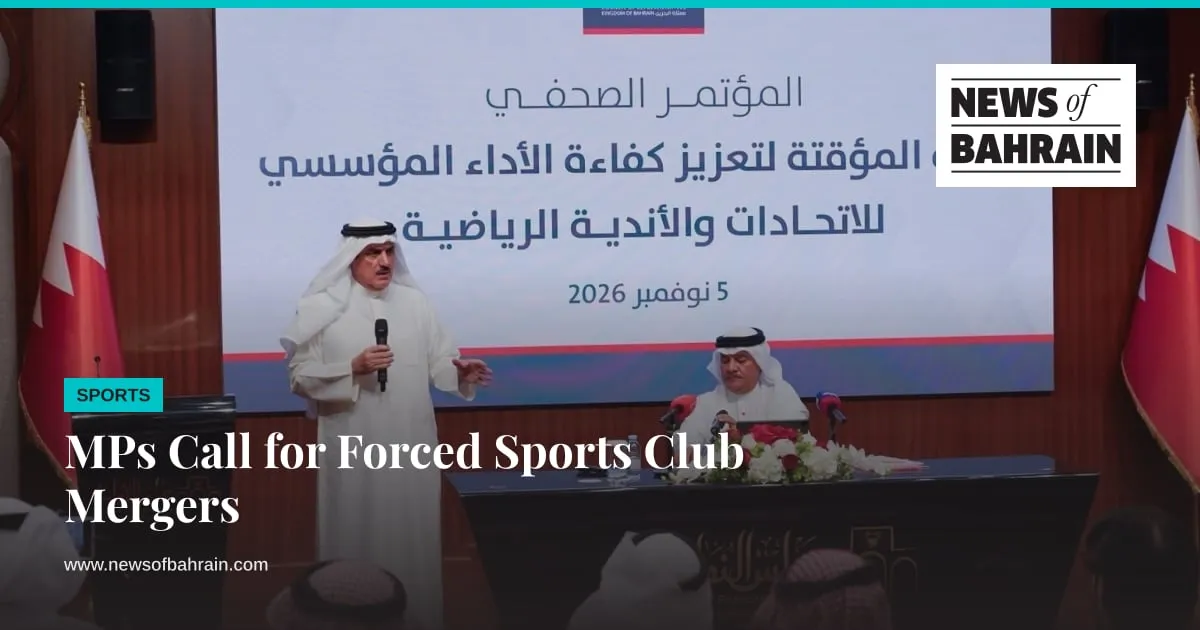
The calls came at a press conference presenting the committee's six-month inquiry, attended by Parliament Speaker Ahmed Al Musallam. Committee members unanimously backed changes to club and federation management; compulsory mergers were among the proposals discussed.
Club income and investment approvals
MP Hassan Ebrahim proposed expanding clubs' income through sponsorships, advertising, donations and rentals of their grounds and buildings. He also sought fewer barriers to business investment and a wider community role for clubs, including tutoring, lessons and youth activities beyond sport.
For businesses seeking approval for sports investments, MP Maryam Al Dhaen called for a single government office to handle applications. Investors, she said, were often uncertain about which authority to contact.
The General Sports Authority told the committee it was examining how to make better use of government land assigned to clubs. MP Eman Shuwaiter separately called for a fairer allocation system, arguing that young people's access to adequate sports grounds should not depend on where they live.
Governance, funding and oversight
The authority also told MPs it was considering funding linked to sporting performance and management standards. Rules being developed for club board candidates would include courses explaining their responsibilities.
Those efforts follow earlier governance proposals. In a May 3, 2026, report, The Daily Tribune (News of Bahrain) said the authority was preparing a governance charter and rules covering performance-based funding and tighter supervision of private sports academies. Parliament was then preparing to debate stronger governance requirements for clubs and federations.
The same report described broad support from clubs and federations, which sought clearer reporting, yearly assessments and tighter financial controls. They also wanted implementation phased in so smaller organizations would have time to adjust.
In September 2026, the authority approved the Khalid bin Hamad Award for Institutional Excellence for Clubs at its ninth board meeting, The Daily Tribune (News of Bahrain) reported. The award is intended to improve club management and standards in administrative, financial and technical operations.
The parliamentary inquiry also considered proposals for mandatory management rules and a dedicated sports law. Clubs currently fall under legislation dating to 1989 that also covers charities and cultural groups.
Developing players, coaches and access
Al Musallam called on clubs, sports bodies and the General Sports Authority to put more resources into developing young Bahraini players instead of pursuing trophies.
"Building national teams should not be tied to immediate results or trophies. It takes years of planning, training and preparing young players for the future," he said.
The inquiry examined private sports academies, talent identification in schools and training for coaches, club employees and referees. Qarata and MP Abdulhakim Al Sheno sought additional training for Bahraini coaches and more opportunities for them to hold senior positions.
School and university sport was also on the agenda at the authority's September board meeting. Members discussed activating a dedicated unit to widen participation, build connections with organized sport and identify promising athletes.
Committee members considered improvements to facilities and specialized training for athletes with disabilities, including deaf athletes. Ebrahim also sought leave arrangements allowing private-sector employees to represent Bahrain abroad without conflicts with their work responsibilities.
Al Dhaen criticized the time taken to obtain responses during the inquiry and said some written answers differed from information given to MPs in meetings. The committee held 11 meetings over six months, including five with government bodies, clubs and sports federations. Its report on finances, investment, management and sports legislation is due for debate at Parliament's next sitting.