Bahrain's Shura Council Rejects Two Driving-License Bills for Non-Bahrainis
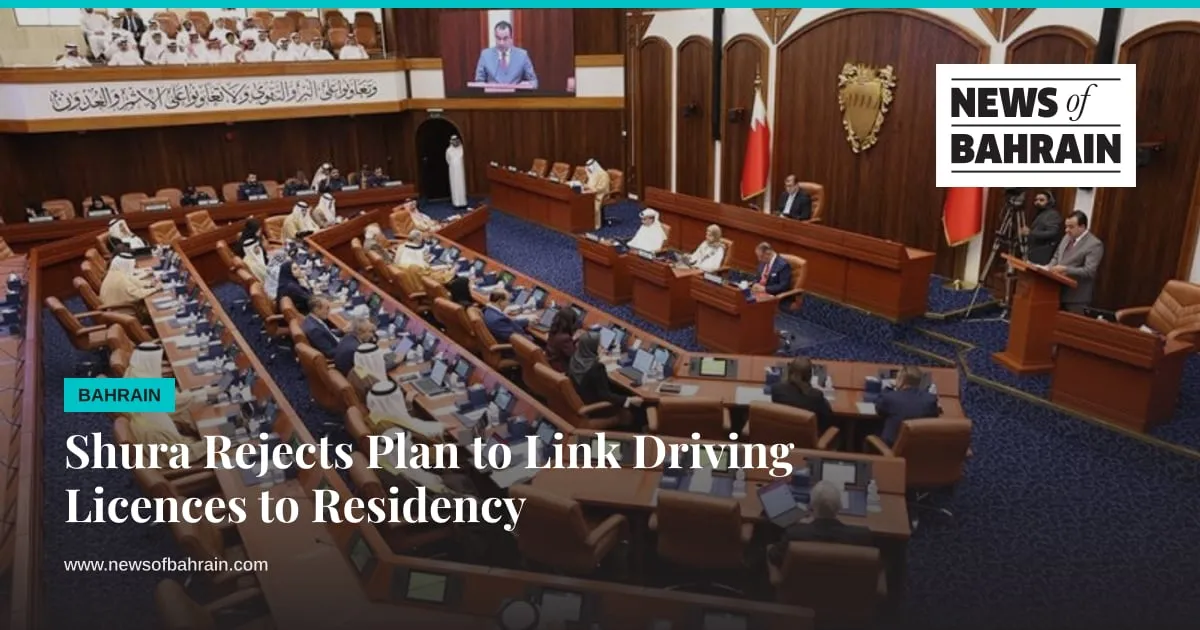
Bahrain's Shura Council voted on November 1, 2026, to reject proposals tying non-Bahrainis' driving licenses to their residency terms and allowing additional licensing conditions through executive regulations. Members cited administrative costs and con...
Key points
- The Shura Council rejected a bill that would have tied non-Bahrainis' driving license validity to their residence permit term.
- The committee said existing rules already require valid residency for non-Bahrainis applying for or renewing licenses.
- Interior Ministry objections warned of renewal cycles from one to five years and added pressure on traffic authorities.
- Members argued that broad executive regulation of licensing conditions could conflict with the Constitution's protection of freedom of movement.
- The Council sent a proposal favoring Bahraini goods in public procurement to the government to be drafted as a formal bill.
Residency link would complicate renewals
Both traffic-law bills had passed the Council of Representatives in April 2026. The Shura Council rejected them in principle and sent them back to the elected chamber for reconsideration.
One bill would amend Article 19 of the Traffic Law to make a non-Bahraini's driving license valid for the same period as their residence permit. Ali Abdulla Alaradi, rapporteur of the Foreign Affairs, Defence and National Security Committee, said existing rules already require valid residency when non-Bahrainis apply for or renew licenses. The committee saw little additional legal benefit in the proposed link.
Instead, the committee warned, residents could face more frequent renewals, differing license terms and harder-to-calculate fees, while authorities would incur additional administrative costs. News of Bahrain reported that the Interior Ministry raised similar objections in written submissions and meetings in November 2024 and January 2025. It warned of renewal cycles ranging from one to five years and added pressure on the General Directorate of Traffic.
Officials also pointed to a mismatch at the other end of the scale: Bahrain's golden residency permit lasts 10 years, compared with the standard five-year driving-license term, according to News of Bahrain.
The committee distinguished the documents' legal functions. A license establishes a driver's technical competence and medical fitness; a residence permit establishes their legal status in Bahrain. Applying the proposed restriction to every non-Bahraini would not specifically target irregular employment, it argued, but could impose financial and administrative burdens on other residents. Driving offenses and unauthorized transport and delivery work are already subject to penalties under existing laws.
Objections to broad executive powers
The other bill would insert Article 19 bis into Traffic Law No. 23 of 2014, leaving executive regulations to determine licensing conditions for non-Bahrainis. Article 228 of the law's implementing regulations already makes a valid residence permit a requirement for foreign residents seeking a Bahraini driving license, News of Bahrain reported.
Alaradi said the committee objected to giving executive regulations unrestricted authority over licensing requirements. Its concern was that such a delegation could encroach on the legislature's role and affect the constitutional protection of freedom of movement.
The committee specifically argued that the bill conflicted with Article 31 of Bahrain's Constitution, which requires legislation governing rights to protect those rights, and Article 19(a), which safeguards personal liberty, including freedom of movement. It also warned of a possible conflict with Article 12 of the International Covenant on Civil and Political Rights.
Bahrain's National Institution for Human Rights raised a related objection, according to News of Bahrain: the essential rules for issuing licenses should be set in law, with regulations confined to implementing them. The council committee also found that the bill offered no specific measures to tackle traffic congestion, although reducing congestion was among its objectives.
An earlier court decision informed the constitutional debate. On July 2, 2014, Bahrain's Constitutional Court struck down a measure that would have denied licenses to most non-GCC expatriates unless driving was required for their jobs. That measure was removed before the Traffic Law took effect. The Shura Council's Legislative and Legal Affairs Committee cited the ruling when questioning the constitutionality of the current Article 19 bis bill, News of Bahrain reported.
Procurement proposal advances to government
The council took a different course on national-industry legislation, endorsing a proposal for legislative consideration and sending it to the government to be drafted as a formal bill. It would direct more public spending toward Bahraini goods and services through amendments to Decree-Law No. 11 of 1985 concerning the Protection and Support of National Industries.
Five Shura members submitted the proposal: Talal Mohamed Almannai, Jamal Mohamed Fakhro, Khalid Hussain Almaskati, Redha Abdulla Faraj and Ali Abdulla Alaradi.
Dr. Anwar Khalifa Alsada, rapporteur of the Financial and Economic Affairs Committee, said the proposal envisages a National Industries Protection and Support Committee. A decision by the prime minister would establish the body and define who serves on it, its duties and how it operates.
The Cabinet would be able to designate national products that government entities subject to public procurement legislation must purchase under specified regulations. The purchasing requirements would cover goods, construction work and services.
The proposal also calls for a method to measure local content in government tenders and minimum local-content requirements for bidders. The calculation would count spending in Bahrain on Bahraini workers, goods, services, assets and other economic activities.
Alsada said the measures aim to make national industries more competitive and sustainable, attract investment, expand local production and create jobs. In his assessment, channeling public purchases toward Bahraini businesses could retain more capital in the domestic economy, strengthen local supply chains and support market stability.
The committee linked the proposal to Bahrain's 2022-2026 industrial strategy, particularly its goals of strengthening industrial security, developing national capabilities and making public spending more effective.
Other business at the session
The votes took place on Sunday during the fourth sitting of the fifth annual session of the sixth legislative term. First Deputy Chairman Jamal Mohamed Fakhro chaired the meeting, attended by Ghanim bin Fadhel Al Buainain, minister of Shura Council and Representatives Council affairs.
Earlier, Secretary-General Karima Mohammed Al Abbasi presented legislative correspondence from the Council of Representatives. A proposed change to Article 4 of Decree-Law No. 41 of 2002, concerning privatization policies and regulations, was assigned to the Financial and Economic Affairs Committee.
The Services Committee received three proposed amendments covering retirement and social insurance: Article 87 of the law governing government employees' pensions and retirement benefits, Article 41 of the Military Retirement Law and Article 90 of the Social Insurance Law. The Legislative and Legal Affairs Committee was notified of these referrals and the privatization proposal.
Fakhro also congratulated Al Abbasi and the General Secretariat's staff on receiving the Best Workplace Organisation Award for 2026 in the public and government sectors. Presented at the 14th Annual GCC Government Human Resources Summit Awards in Abu Dhabi, the award recognized the Secretariat's work in staff development, workplace improvements, digital solutions and innovative administrative practices.