Oman urged to make fuller use of U.S. trade pact as commerce stagnates
Oman's free trade agreement with the United States has delivered too little growth in bilateral commerce, Dr. Hilal al Sawai argues in the Oman Observer. He identifies shipping costs, compliance burdens and cautious business practices as obstacles to r...
Key points
- Bilateral trade was estimated at $3.2 billion in 2021 and $3.3 billion in 2025 according to al Sawai.
- U.S. goods exports to Oman rose 12.5 percent in 2025 to $2.2 billion, while imports from Oman fell 15.1 percent to $1.1 billion.
- The U.S. goods trade surplus with Oman reached $1.1 billion in 2025, up 70.3 percent, per the Office of the U.S. Trade Representative.
- Al Sawai says the U.S. requires 35 percent local value added for a product to qualify as Made in Oman, which burdens factories sourcing raw materials abroad.
- Oman became the first Persian Gulf state to formally permit U.S. military use of its facilities in 1980, according to the Congressional Research Service.
Limited growth, uneven trade flows
Oman is among just 20 countries with a comprehensive U.S. free trade agreement. The two countries signed the pact in 2009, giving Oman, alongside Bahrain, preferential access to the world's largest consumer market. Yet al Sawai puts bilateral trade at $3.2 billion in 2021 and $3.3 billion in 2025, describing an opportunity that remains underused across Oman and the wider Gulf economy.
Figures from the Office of the United States Trade Representative show how unevenly trade moved in 2025. U.S. goods exports to Oman rose 12.5 percent from 2024 to $2.2 billion, while imports from Oman fell 15.1 percent to $1.1 billion. Total goods trade was an estimated $3.3 billion, and the U.S. goods trade surplus reached $1.1 billion, up 70.3 percent. Separately, the agency estimated bilateral services trade at $969 million.
Automobiles, aviation and industrial products dominate U.S. sales to Oman, according to al Sawai. In the other direction, American buyers purchase Omani industrial supplies, bauxite, aluminum, fertilizers, jewelry, plastics and fuel oil. Omani aluminum plating exports exceeded $231 million in 2024, while jewelry exports exceeded $218 million.
For August 2026, al Sawai identifies raw plastic sheeting, at $29.4 million, nitrogenous fertilizers, at $24.9 million, and cyclic hydrocarbons, at $20.5 million, as leading exports.
Shipping, tariffs and compliance
Distance is one practical disadvantage for Omani exporters: al Sawai says deliveries to Britain or continental Europe take less time and cost less than shipments across the Atlantic to U.S. ports. He also says the 2026 UK-GCC free trade agreement has eased commerce by eliminating tariffs on all current imports from the GCC.
The UK government dates the conclusion of that agreement to May 20, 2026, making Britain the first G7 country to secure a trade deal with the bloc, whose members include Oman. For trade in the opposite direction, the government estimates that full implementation will remove about £580 million in annual duties on UK goods exported to the GCC. Of that amount, £360 million is to be removed when the agreement enters into force.
Al Sawai also sees a gap in businesses' knowledge of U.S. customs procedures. Omani goods are eligible for the U.S. Customs Reconciliation program, which allows an entry summary to use best estimates without penalties when exact values are not yet available.
Qualifying a product as "Made in Oman" presents another challenge. Al Sawai says the U.S. requires 35 percent local value added, leaving factories that source raw materials from neighboring countries struggling to document and track compliance. He also cites an additional 12.5 percent tariff above base rates tied to Section 301 labor-rights scrutiny.
A separate tariff measure is described by the Congressional Research Service: the White House announced a 10 percent reciprocal rate on Omani goods in April 2025 and reaffirmed it in late July that year. Some product categories face higher tariffs globally, including aluminum, which Oman exports.
Beyond shipping and regulation, al Sawai argues that Omani companies' cautious approach can slow transactions in a fast-moving American market. He contrasts that approach with the more aggressive operations of businesses in the UAE and Saudi Arabia, which he credits with successfully pursuing the U.S. market.
A strategic relationship beyond commerce
The limited growth in trade sits alongside a long-standing security relationship. Al Sawai describes Oman's location as important to U.S. navigation of naval chokepoints, competition with Iran and China, and efforts to support regional stability involving Yemen.
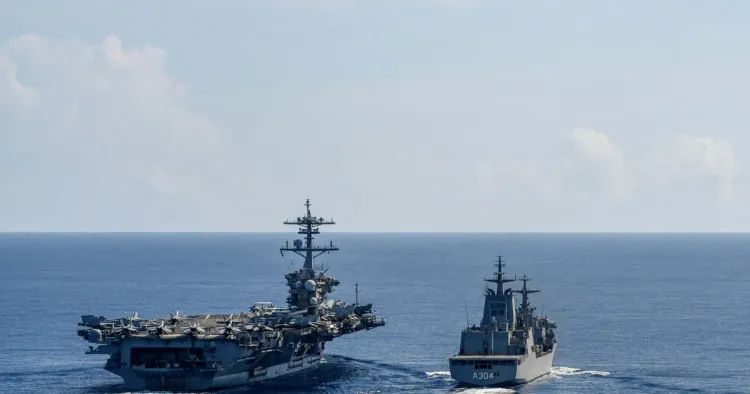
According to the Congressional Research Service, Oman became the first Persian Gulf state to formally permit U.S. military use of its facilities in 1980. A Strategic Framework Agreement signed in March 2019 widened that access to include the ports of Salalah and Duqm. Duqm can accommodate U.S. aircraft carriers, the report says.
Trade offices and regional partnerships
Al Sawai calls for closer scrutiny of business entities, stronger corporate practices and more active cross-border engagement to advance Oman Vision 2040. He points to the 2025 opening of Oman's trade office in the United States, followed by a memorandum of understanding between the U.S. Embassy and the American Chamber of Commerce of Oman, as steps toward addressing gaps in the commercial relationship.
The Oman Chamber of Commerce and Industry inaugurated the Omani Trade Office on May 14, 2025, at the Sultan Qaboos Cultural Center in Washington, D.C., according to Oman's Foreign Ministry. Funded by the chamber, the office is intended to help Omani exporters reach U.S. buyers, attract American investment to Oman and advise companies on using the free trade agreement.
Other initiatives include closer ties with Arizona through the State Partnership Programme and work to finalize a Sister Port memorandum of understanding between Louisiana and Duqm. Al Sawai also advocates strict compliance frameworks, containment protocols, changes to established business practices and more varied economic opportunities for Omani small and medium-sized enterprises.