Bahrain's Ports Undersecretary Discusses Maritime Links and Safety in London
Bahrain's Undersecretary for Ports and Maritime Affairs, Bader Hood Al Mahmood, held talks in London on port connections, maritime safety and technology during the International Maritime Organisation's 138th Council session. His meetings brought togeth...
Key points
- Bahrain's undersecretary and Saudi Ports Authority president discussed improving direct port connections to facilitate goods and transit cargo movements.
- The Gulf Shuttle service, operated by MSC, links Dammam's King Abdulaziz Port with Bahrain's Khalifa bin Salman Port with capacity up to 3,000 TEUs.
- Five Saudi Ports Authority services together have a combined capacity of approximately 63,594 TEUs, introduced to limit Strait of Hormuz disruption impact.
- A planned King Hamad Causeway would combine road freight and rail as a second Bahrain-Saudi link, expected to carry 95 million metric tons by 2045.
- Khalifa bin Salman Port connects to Bahrain International Airport through the Global Sea-to-Air Hub, with a two-hour end-to-end bonded lead time.
Connections between Bahrain and Saudi Arabia
According to Bahrain News Agency, Al Mahmood, of the Ministry of Transportation and Telecommunications, discussed shared maritime priorities and opportunities for cooperation. His meeting with Saudi Ports Authority President Suliman bin Khalid Al Mazroua focused on improving direct connections between the two countries' ports to facilitate goods and transit cargo movements, as well as broadening cooperation in ports and maritime navigation.
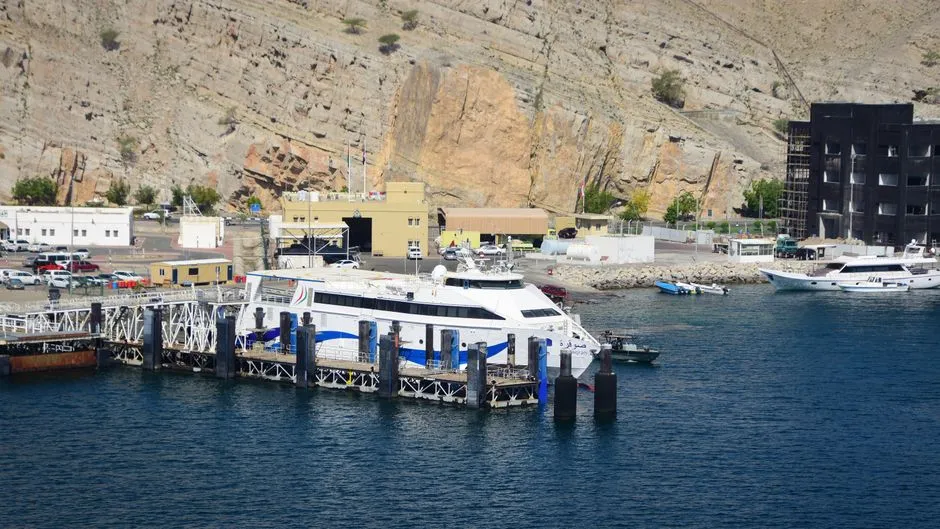
The discussions followed the Saudi Ports Authority's September 2026 announcement of the Gulf Shuttle service. Operated by MSC, the service links King Abdulaziz Port in Dammam with Bahrain's Khalifa bin Salman Port and has a capacity of up to 3,000 TEUs.
The authority, also known as Mawani, introduced Gulf Shuttle alongside four other services: Redex, Jade, AE19 and SE4. Launched with MSC, CMA CGM, Maersk and Hapag-Lloyd, the five services have a combined capacity of approximately 63,594 TEUs. They were introduced as part of efforts to limit the impact of disruption in the Strait of Hormuz.
A separate planned connection, the King Hamad Causeway, would combine road freight and rail in a second link between Bahrain and Saudi Arabia, according to Bahrain's Minister of Transportation and Telecommunications, Abdulla bin Ahmed Al Khalifa. The causeway is to join the wider 2,117-kilometer GCC Railway network and is expected to carry 95 million metric tons of goods by 2045.
Khalifa bin Salman Port, operated by APM Terminals, also connects to Bahrain International Airport through the Global Sea-to-Air Hub. A streamlined clearance process allows a two-hour end-to-end bonded lead time between the port and airport. Bahrain's transport minister says this reduces delivery times by half and costs by 40% compared with other routes. A World Economic Forum account describes the port as the region's first fully solar-powered seaport and notes its recognition as the world's most efficient small port.
Digital procedures, navigation and safety
Al Mahmood's talks with Egypt's Rear Admiral Staff Hussein Mostafa Al Jazeeri covered transit traffic and maritime connections, alongside efforts to digitize procedures and implement single-window systems. They also coordinated their positions on matters before the IMO.
With Hessa Al Malik of the United Arab Emirates, Al Mahmood discussed closer bilateral maritime cooperation and coordination on navigation issues.
Ship registration and emissions reduction were among the subjects addressed with Dr. Christos Atalianis of Cyprus. Their review of maritime cooperation also covered safety, search and rescue, and exchanges of technical expertise.
British officials and experts met Al Mahmood to discuss navigational aids and electronic navigation applications. The talks also addressed training and capacity-building for national personnel working in maritime safety and navigation.
Council agenda and decisions
The IMO Council met at the organization's London headquarters from November 2 to 6, 2026, with in-person attendance and hybrid participation. Victor Jimenez of Spain chaired the session. The Council serves as the IMO's executive organ, with 40 member states elected by the Assembly to two-year terms.
Its agenda covered strategy and planning, resource management, including financial reports, and the secretary-general's contract. Protection of vital shipping lanes was another focus, encompassing the Strait of Hormuz, the Black Sea and Sea of Azov, and the Red Sea regions.
In closing remarks on November 6, the IMO secretary-general reported that the Council had condemned attacks on merchant vessels and seafarers in the Red Sea and Bab al-Mandeb Strait, as well as attacks affecting Ukraine's special maritime corridor in the Black Sea.
The Council also approved an initial GBP 2 million allocation from Technical Cooperation Fund reserves for an upgrade to the Global Integrated Shipping Information System, known as GISIS, and the development of an e-learning platform.
It decided to recommend a further four-year term for Secretary-General Arsenio Dominguez, ending December 31, 2031. The Council also noted July 19-23, 2027, as the proposed dates for its 139th regular session in London.