UAE Food Bank signs cooperation charter with partners in Kuwait, Qatar and Bahrain
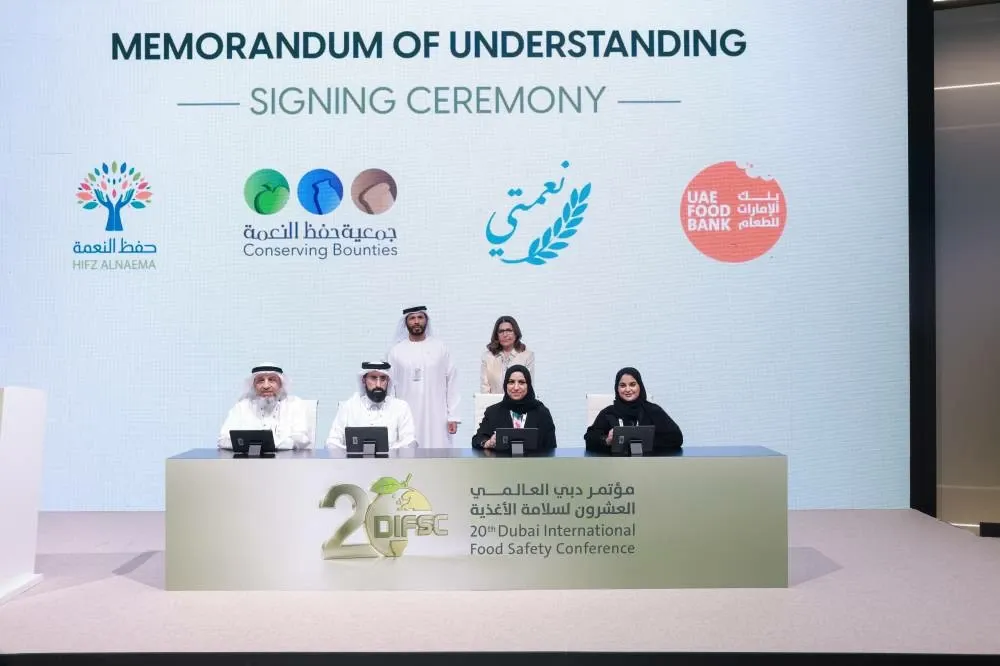
Four Gulf food preservation organizations have agreed to share expertise on recovering surplus food and distributing it safely. The UAE Food Bank Foundation signed the GCC Food Banks Cooperation Charter with partners from Kuwait, Qatar and Bahrain, cre...
Key points
- The four partner organizations will share practical know-how across collection, handling, storage, transportation and identifying beneficiary communities.
- Food safety standards and operational experience will be shared so partners can recover food more effectively while handling it responsibly.
- The charter includes training support and skill development for employees and volunteers through shared expertise.
- Partners will exchange approaches to planning, performance measurement and institutional procedures, and will meet periodically to assess progress.
- The charter allows partners to support one another during emergencies and crises, in line with each country's laws and approved procedures.
Cooperation from collection to delivery
The signatories are the UAE Food Bank Foundation; Kuwait's Naemati, a nonprofit organization; Qatar's HIFZ ALNAEMA Center; and Bahrain's Hefth Al Nema Society. Their cooperation will cover the practical steps involved in redistributing surplus food, from collection and handling to storage, transportation and identifying communities and people who could benefit.
Food safety is a central concern. The partners plan to share standards and operational experience to help them recover food more effectively while handling it responsibly. They will also compare approaches to planning, measuring performance and managing institutional procedures.
The charter provides opportunities to develop employee and volunteer skills through shared expertise and training support. Exchanges will also take place at regional and international forums, conferences and specialized events focused on reducing food waste and developing the food banking sector.
Manal Obaid bin Yaroof, head of the UAE Food Bank Foundation's executive team, said partnerships and ongoing knowledge exchange are necessary to reduce waste and make better use of surplus food. She said the charter would help Gulf food preservation organizations learn from one another and improve their operations.
Building on existing food bank partnerships
The UAE Food Bank began in 2017 as a charitable organization under the Mohammed bin Rashid Al Maktoum Global Initiatives, according to the UAE government's official platform. It was the country's first food bank, and its stated goals include a 30% reduction in food wastage by 2027.
Its 2024 annual figures, reported by Dubai Municipality, recorded 28.9 million beneficiaries worldwide, up 55% from 2023, and 5,466 metric tons of food diverted from landfills. By that reporting point, the bank had distributed more than 96 million meals since its founding and developed a network of 262 strategic partners. It had also signed five memoranda of understanding with regional food banks.
Mohammed Yousef Al-Muzaini, president and founder of Naemati Company in Kuwait, thanked the UAE Food Bank for organizing the event and facilitating the collaboration. He said the partners would work to turn the charter into practical initiatives with tangible community benefits.
Ali Ayedh Al Qahtani, executive manager of Qatar's HIFZ ALNAEMA Center, said his organization wanted both to learn from its regional partners and to share its experience. He described closer cooperation as a way to improve recovery, safe redistribution, team capabilities and food safety practices.
The scale of food waste in the Gulf
A 2025 Oliver Wyman analysis citing UNEP data put annual food waste across GCC countries at an average of 150 kilograms per person, 14% higher than the global average of 132 kilograms. The analysis estimated that Gulf retailers alone wasted about 1.3 million metric tons of food in 2022, representing roughly $4 billion to $7 billion in annual losses.
Household estimates show differences across the region. UNEP's Food Waste Index Report 2024, as compiled by Wady, lists annual household waste per person at 132 kilograms in Bahrain, 105 kilograms in Saudi Arabia, 99 kilograms in each of Kuwait, Oman and the UAE, and 93 kilograms in Qatar. Each exceeds the global household average of 79 kilograms.
Those household estimates do not carry the same level of certainty. Only the Saudi Arabian and Qatari figures are rated high confidence; the estimates of 99 kilograms for Kuwait, Oman and the UAE were modeled.
Thawra Ibrahim Al Dhaen, CEO of Bahrain's Hefth Al Nema Society, said the partnership seeks to advance charitable and humanitarian work while encouraging food preservation and responsible use of surplus food. She said closer regional cooperation could strengthen the organizations' work and their service to Gulf communities.
National targets and regional food security
The UAE also has a national food loss and waste initiative, ne'ma, which aims to halve both by 2030. As Wady's compilation of UNEP and UN sources notes, that target goes beyond UN Sustainable Development Goal 12.3: the UN goal calls for halving food waste but only reducing food loss.
At the GCC level, Secretary General Jasem Mohamed Albudaiwi described agriculture and food security as a strategic priority during the 38th Meeting of the Committee of Agricultural Cooperation and Food Security in Manama on September 3, 2026.
He also cited directives from the Supreme Council's 19th Consultative Meeting, held in Jeddah on April 28, 2026. Those included studying the establishment of GCC strategic storage zones.
Emergency assistance and implementation
Beyond routine operations, the charter allows the participating organizations to support one another during emergencies and crises. Any such assistance must follow the laws and approved procedures of their respective countries.
The partners will meet periodically to assess progress, share updates and identify further opportunities for cooperation.